
Medium length hairstyles for men sit between a short fade and long hair, with about 3 to 6 inches (7 to 15 cm) on top. At that length you can slick the hair back, sweep it to the side, or leave it loose and textured, which is why the range suits so many hair types and work settings.
This guide lists 45 styles, each with a tip for what to ask your barber. Before the list, it shows how to match a cut to your face shape and hair texture. After it, you will find the barber terms worth knowing, how to get through the awkward growing stage, and the products and routine that keep the cut in shape.
The Rise of Medium Length Hairstyles for Men in 2026
Medium length stays popular because it solves problems the other lengths do not. It has enough hair to style in several ways, but not so much that you need a long-hair routine. A short cut needs a barber every few weeks, while long hair needs months of patience. Medium length sits between the two.
Why Choose Medium Length Hairstyles for Men?
You can slick it back for a meeting or leave it loose on the weekend, and the extra length hides small flaws such as an uneven hairline or a flat spot at the crown. It also grows out more gracefully than a short fade, so a late trim is less noticeable.
It is not for everyone. It takes a few more minutes each morning than a short cut, and thin hair can look sparse at this length unless the cut keeps some weight. If you want almost no styling, a short cut is easier.
Quick Comparison: Which Medium Hairstyle Suits You?
This table filters the styles by hair type and daily routine, so you can narrow the list before you read all 45.
| Style Category | Best Hair Type | Maintenance Level | Best Face Shape |
| Modern & Edgy | Thick / Straight | High | Oval / Square |
| Professional | Straight / Wavy | Medium | All Shapes |
| Low Maintenance | Wavy / Curly | Low | Heart / Round |
| Texture Specific | Very Curly | Medium | Angular / Oval |
How to Choose the Best Medium Length Hairstyles for Men by Face Shape
Face shape decides where a cut should add height, width, or softness. Find your shape below, then use the style numbers to jump to the matching cuts in the list.
Which Cut Suits Each Face Shape
Oval faces suit almost every cut, so choose by hair type and by how much time you want to spend. Try the Textured Quiff (style 7) or the Classic Side Part (style 14).
Round faces look longer with height on top and trimmer sides. Try the Textured Quiff (style 7), the Pompadour Fade (style 13), or the Curly Quiff (style 36), and avoid a heavy fringe cut straight across.
Square faces have a strong jaw that soft, textured cuts balance. Try the Messy Fringe (style 12), the Shaggy Layers (style 9), or the Natural Wave Flow (style 27), and keep the sides from getting too boxy.
Heart-shaped faces have a wide forehead and a narrow chin. A fringe covers part of the forehead, and extra length at the sides adds balance. Try the Relaxed Fringe (style 28) or the Long Wavy Fringe (style 39).
Diamond faces are widest at the cheekbones. Add some width at the forehead and avoid very tight sides. Try the Layered Side Sweep (style 19) or the Messy Fringe (style 12), and avoid slicking everything straight back, which makes the cheekbones look sharper.
Oblong faces are longer than they are wide. Avoid extra height on top and choose cuts with width at the sides, such as the Natural Wave Flow (style 27) or the Surf Inspired Flow (style 22).
The Best Medium Length Hairstyles for Men Based on Your Hair Texture
Hair texture decides how a cut sits once it is longer than a few inches. Thick hair needs weight taken out, thin hair needs weight kept in, and straight hair needs help to hold any movement. Pick the cut for your texture first, and the styling gets much easier.
Top Medium Length Hairstyles for Men with Thinning Hair
Thinning hair looks fuller when the cut gives it height and movement instead of length. A textured quiff or short, messy layers lift the hair off the scalp, so less of it shows through. Keep the sides short and tidy, because long sides on thin hair tend to look wispy.
Skip heavy gels and pomades, which clump the hair together and reveal the scalp. A lightweight mousse or a little sea salt spray on damp hair gives each strand some grip, and blow-drying the roots upward adds lift. If the thinning is at the front, keep the fringe a little longer so it covers that area.
Managing Thick & Coarse Hair: The Best Medium Cuts
Thick hair holds a medium length well, but the density can make the sides puff out. Ask your barber for internal thinning, which removes weight from inside the hair without shortening it. Styles such as the Tapered Bro Flow (style 18) or the Disconnected Undercut (style 4) work well because they use the extra volume.
Coarse hair also tends to be dry, so it needs moisture before it needs hold. A leave-in conditioner or a few drops of hair oil on the ends softens the strands, and a stronger product such as clay then holds the shape. Without that, thick hair looks wild instead of intentional.
How to Style Straight, Flat Hair for More Movement
Straight hair tends to lie flat at medium length, because it has no bend to hold volume. Layers and point cutting break up the flatness and add texture to the ends. Without them, straight hair can look limp.
Build the lift in the styling. Apply sea salt spray or a little clay to damp hair, then blow-dry the roots upward or dry the hair upside down. That gives lift at the roots that lasts longer than product alone.
The Definitive List of 45 Best Medium Length Hairstyles for Men
1. The Modern Wolf Cut

The wolf cut blends a shag with a mullet: short layers around the crown, longer layers at the sides and back, and a fringe that melts into all of it. At medium length it gives plenty of movement without the length of a full shag. It suits wavy hair best, because the layers give the waves room to show.
Straight or fine hair needs more care, since too many layers can look thin. Ask for fewer, longer layers and keep the weight at the ends. A good request is “disconnected layers with point cutting on the ends.” Finish with a little sea salt spray on damp hair for the messy look.
2. Textured Mullet

The textured mullet keeps the sides short and the back long, but blends the two so the cut does not look like a sharp step. It suits wavy and curly hair, because the texture hides the join between the lengths. If you like the shape but want more length at the back, a modern mullet is where this style goes next.
Ask your barber for:
- A taper fade on the sideburns, not a skin fade
- Short temples, with the length kept from the crown to the nape
- Point cutting on the back, so the ends look soft instead of blunt
3. Burst Fade Mohawk

A burst fade cuts a curved fade around the ear that follows the shape of the head, then leaves the length from the forehead to the nape. The curve draws attention to the profile and the jaw. It works best on hair with natural volume, because the top has to hold its own against the contrast.
Common mistake: asking for a “burst fade” without saying how short the sides should go. A burst fade can be low or high, so name a guard number (a #1 or #2, for example) and where the fade should stop. Expect a visit every 2 to 3 weeks, because the contrast grows out quickly.
4. Disconnected Undercut

The disconnected undercut keeps the top long and the sides very short, with no blend between them, so there is a clear break. It shows off length and volume, and it suits thick, straight hair that can hold the top in place. It is bolder than a taper or a fade, and it looks wrong if the line between the two sections is uneven.
To get it right:
- Ask for a #1 or #2 guard on the sides and say clearly that you do not want a blend.
- Keep the top at 3 to 6 inches, so it falls over the line instead of ending at it.
- Style the top back or to the side with matte clay, which keeps the contrast sharp.
Plan on a trim to the sides every 3 to 4 weeks.
5. Tapered Blowout

The tapered blowout pairs neat, tapered sides with a top that is blow-dried upward and slightly back, for height and a windswept look. A taper stays longer than a fade, so the sides keep a soft edge. It suits thick hair that holds volume, and it works for both an office and a weekend.
The volume comes from the blow-dry, not from product. Dry the top upward with a vent brush, finish with cool air to set it, then add a little matte clay. When you search for reference photos to show your barber, blowout taper is the more common name for this cut. Ask for a low taper on the sideburns and neckline, and keep the bulk on top.
6. The Edgar Cut

The medium Edgar cut has a blunt fringe cut straight across the forehead and very short sides, usually a high fade. The contrast between the thick top and the faded sides is what defines it. Hair with a straight, dense line suits the fringe because it maintains the straight line.
The cut is only as good as the fringe line, since any unevenness shows. Ask your barber to cut the fringe dry, so you can see where it will sit. If you have a cowlick at the front, the line can split, so say so before the first cut. A trim to the sides every 2 to 3 weeks keeps the fade clean.
7. Textured Quiff
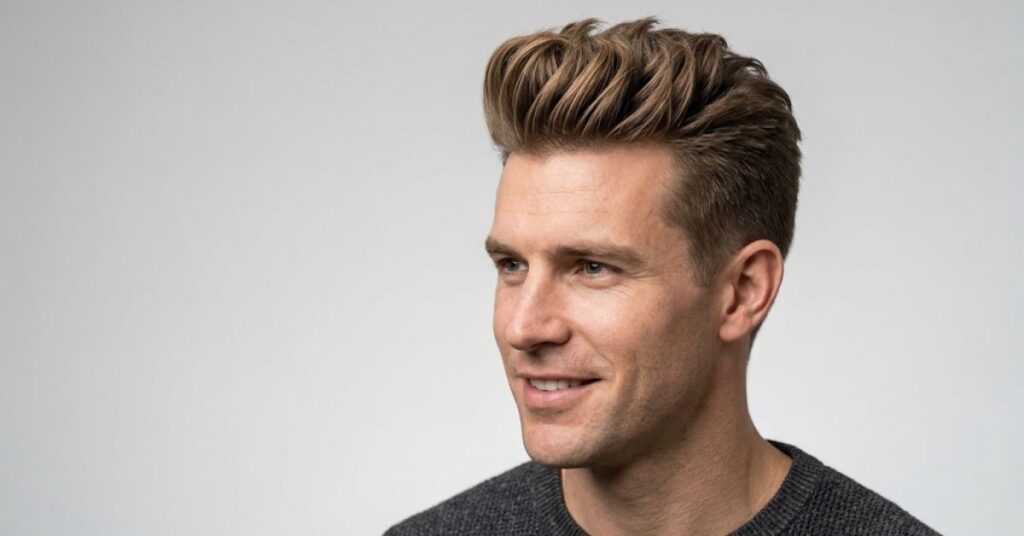
The textured quiff lifts the front of the hair up and back, then breaks it up with point cutting so it looks loose instead of combed. A round face is made longer by its height. The textured version is the easiest of the many quiff hairstyles for men to wear day to day, since it needs clay and a blow-dryer, not a comb and hard-hold pomade.
- Pick it if you have a round or oval face and 4 to 5 inches of hair at the front.
- Skip it if your hair is very fine and flat, because it will not hold the lift without a lot of product.
8. Faux Hawk

The faux hawk pushes the hair into a soft peak down the centre, while the sides stay tapered but not shaved. Unlike a burst fade mohawk, the sides keep some length, so the shape is easy to grow out. It needs about 3 to 4 inches on top, and it suits men who want an edge without a dramatic cut.
To style it:
- Dry the hair upward with a blow-dryer, so the centre stands up.
- Warm a pea-sized amount of paste or clay in your palms.
- Push the sides inward with your fingers and pinch the centre into a peak.
Keep the peak soft. A hard, spiky finish pushes it toward looking dated.
9. Shaggy Layers

Shaggy layers are cut throughout the head, not just at the crown, so the whole cut looks rough and full of movement. That separates it from the wolf cut above, which has a mullet shape at the back. It suits wavy hair, because the layers give the waves room, and it needs very little styling.
Common mistake: asking for razor-cut layers on frizzy, coarse, or very curly hair. A razor can fray the ends and make the frizz worse. You can keep the razor for straighter, finer hair, and ask for scissor layers with point cutting if your hair frizzes.
10. Slicked Back with a Taper

This cut keeps the top long enough to comb straight back and tapers the sides neatly, so the finish looks tidy instead of flat. It suits straight hair with 3 to 4 inches on top. The taper stays longer than a fade, which keeps the look professional and easier to grow out.
A water-based pomade on damp hair gives control without the greasy finish, and a fine-tooth comb sets the lines. If you want to see how far the style can go, there are many slick back hairstyles for men beyond this tapered version. If the hair springs forward at the hairline, hold it back with a blow-dryer while it dries.
11. Side Swept Ivy League

A short, tapered side and a slightly longer top with one side parted and combed are defining characteristics of the Ivy League cut. It is neat without being severe, which is why it works for both an office and a casual day. An oval face looks best with straight to slightly wavy hair.
The part decides how the cut looks. If you want a clean line that stays put, ask for a hard part, where the barber shaves a thin line into the hair. If you prefer a softer look, find your natural part and let the top fall from there. Trim every 4 to 6 weeks, because the short sides grow out faster than the top.
12. Messy Fringe

The messy fringe lets the front of the hair fall loosely over the forehead instead of combing it back. The loose pieces break up the face and cover part of a high forehead or hairline. It is one of several haircuts for big foreheads that rely on a fringe, and it works best on medium-textured hair that clumps naturally.
Common mistake: cutting the fringe too short. Hair springs up when it is cut, so a fringe that looks right at the barber can sit above the eyebrows by the next morning. Ask your barber to leave it a little longer than you want, and to thin the bulk with thinning shears, not scissors, so it does not feel heavy.
13. Pompadour Fade

The pompadour fade puts a lot of volume at the front, swept up and back, over sides that are faded close to the skin. The contrast between the two makes it one of the boldest cuts in this list. This hairstyle is a sharper cousin of the modern pompadour, which keeps the sides and top longer.
To style it:
- Make sure the roots are lifted at the roots by blow-drying the front upward and back.
- Warm a small amount of pomade in your palms and work it through from the roots to the ends.
- Allow the volume to hang over the top of the front and back.
Make sure your barber leaves enough length at the front to wrap back over the rest of the hair. The fade needs a visit every 2 to 3 weeks.
14. The Classic Side Part

The classic side part is a clean division on one side, with the hair combed across to cover the rest. It is the most traditional of the cuts here, and it looks tidy on straight hair, which holds the comb lines. It needs very little product, so it is easy to wear every day.
Ask your barber for:
- A part on the side your hair naturally falls toward, so it does not spring back
- A tapered neckline, so the back stays clean as the hair grows
- A trim every 4 to 6 weeks, since a side part looks messy as soon as the sides grow
Comb it while the hair is damp, then let it dry in place.
15. Low Volume Pompadour

The low volume pompadour is the quieter version of the pompadour fade above. The hair is swept back with moderate height instead of a tall wave, and the sides are blended, not faded to the skin. The result looks groomed and still reads as a pompadour, which makes it easier to wear in a conservative workplace.
The finish matters more than the height. A light matte clay keeps the hair soft and natural, where a high-shine pomade makes it look more dramatic. Ask your barber for blended sides and about 3 to 4 inches on top, and dry the front back with a blow-dryer, without lifting it high.
16. Natural Flow

The natural flow is the least styled cut here. The hair is swept back loosely and tucks behind the ears, and its own weight holds it in place, so there is no taper and very little product. It needs about 4 to 5 inches of hair and works best when the hair is thick and healthy, because thin hair will not hold the shape without help.
The sides are where it goes wrong. If they are left bulky, the hair puffs out instead of lying back. Ask your barber to remove weight from the sides with thinning shears, and keep the length. Wash two or three times a week and use conditioner on the ends, since dry hair will not sit flat.
17. Mid Length Scissor Cut
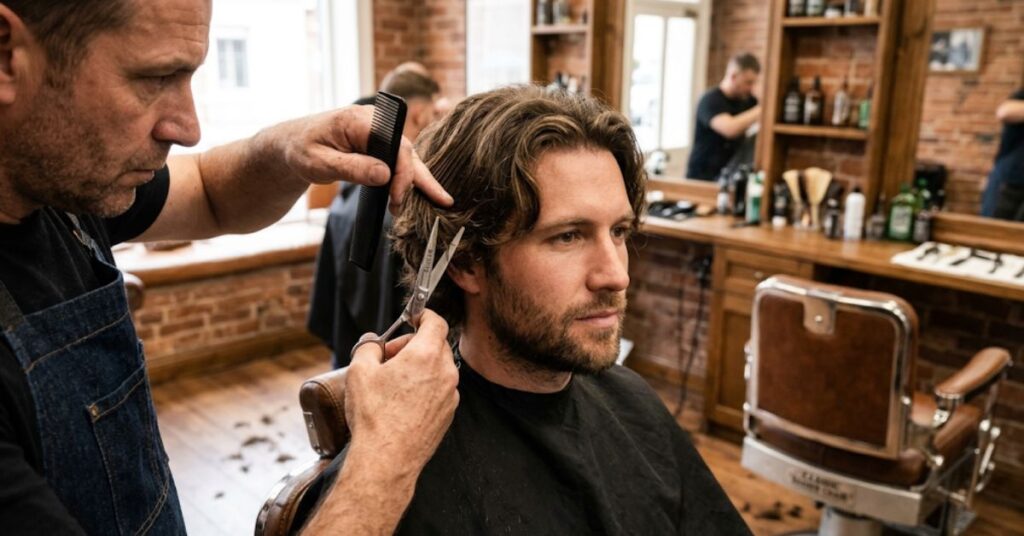
A scissor cut uses no clippers, so the transitions are soft and the hair grows out without a hard line. It takes longer in the chair, but the cut ages better, because the shape follows your natural growth pattern. Ask for a 100% shear cut and tell the barber how much length you want to keep.
- Pick it if you like a soft, natural outline and can book every 6 weeks without the sides looking overgrown.
- Skip it if you want very short, sharp sides, because scissors cannot get that close and clean.
18. Tapered Bro Flow

The tapered bro flow combs the hair back and tucks it behind the ears, with the sides tapered so the area around the ears stays tidy. The taper is what separates it from the natural flow above, where the sides are left to grow. Growing into this length from a short cut takes months, and the flow hairstyle for men breaks that down month by month.
Ask your barber for:
- A short taper around the ears and the neckline
- The length kept on top, so the hair can reach behind the ears
- A trim every 4 to 6 weeks on the sides only
19. Layered Side Sweep

This cut combines layers with a side sweep, so the hair has movement but still looks organised. Internal layers, which are cut under the surface, add volume while the top stays smooth, and that is what stops the sweep from looking flat under office lighting. It suits straight to wavy hair of medium thickness.
To style it:
- Part the hair where it naturally falls and dry it with the dryer pointed in the direction of the sweep.
- Work a small amount of light cream through the ends.
- Set the fringe with a light-hold spray, and skip strong gels, which make the layers stick together.
20. Short Sides Long Back
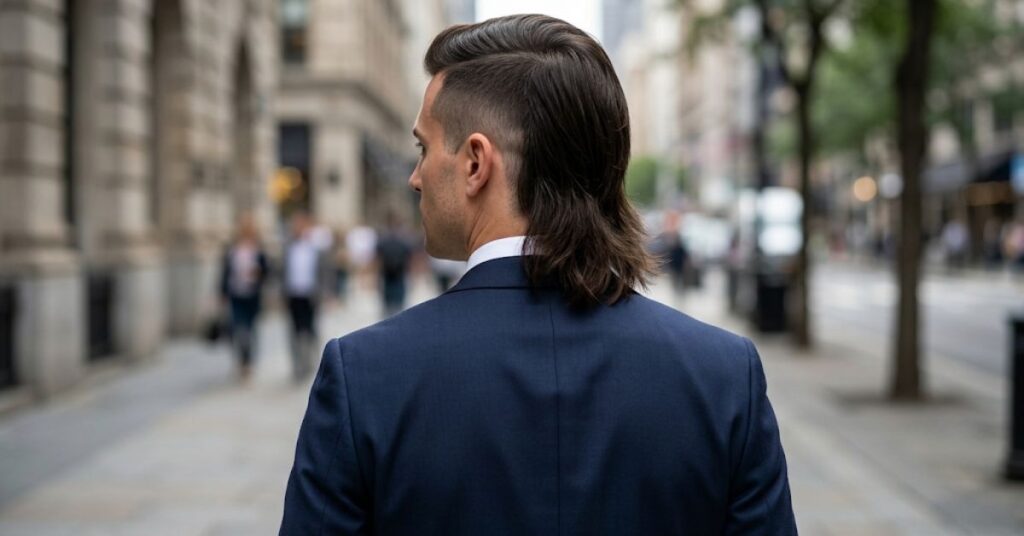
This is a milder cousin of the mullet. The sides are cut tight and the back is allowed to grow to the collar or just past it, so the shape is clear from the side but looks restrained from the front. It reads as a business haircut once the back is kept tidy, which is why it works with a suit.
The transition from the ears to the back decides whether it looks planned. Ask for a taper there, not a sudden drop, and keep the back from passing the top of the shoulders. If you want more length later, you can grow it toward a full mullet without starting over.
21. The Bedhead Look

The bedhead look is a short layered cut that is meant to look slept in. The layers are cut shorter and thinned, so the hair falls in loose, uneven pieces without any styling. It suits thick or wavy hair, because both give the cut its own texture, and it takes about two minutes in the morning.
Common mistake: asking for “messy” without saying how it should be cut. A barber who hears “messy” may leave the hair uncut and ragged, which looks unplanned. Ask for a choppy cut done with scissors and point cutting, then rough it up with a little matte paste. Straight, fine hair rarely holds this look, so skip it if that is your hair.
22. The Surf Inspired Flow

This is the beachy version of the flow: the hair falls loosely behind the ears, with no taper and no hard line. It looks best on wavy hair, since waves give it the soft movement. Point cutting on the ends keeps it light, so the hair does not sit in a heavy block.
Salt water gives the look its texture, and a spray of sea salt on damp hair does the same job at home. For more length-based ideas on the same style, men’s long surfer hairstyles go further than this one. The hair dries most naturally if let air dry, and conditioner is best applied to the ends because sun and salt can damage it.
23. Messy Curls with a Taper

The tapered curly cut keeps the sides short and clean, and leaves the curls on top long, so they become the main feature. Curly hair looks shorter dry than wet, so the top needs more length than you expect. If you are still choosing between curly looks, these cool curly haircuts for guys show a wider range.
Ask your barber for:
- A low taper, so the focus stays on the curls
- Scissor cutting on top, done on dry hair, so the barber sees where each curl sits
- A trim every 6 to 8 weeks
Apply a curl cream to damp hair, scrunch it upward, and leave it alone while it dries.
24. Textured Top with Short Sides

This cut puts all the texture on top and keeps the sides short, which is why it works for people with little time. The top is cut with texturizing shears, which remove small amounts of hair and leave the top with built-in volume. A small amount of clay on dry hair is enough to finish it, so it takes about five minutes.
- Pick it if you want a tidy cut that needs very little effort, and your hair is medium to thick.
- Skip it if your hair is very fine, because texturizing removes density, and fine hair has little to spare.
25. The Modern Man Bob

The man bob is the longest cut in this list, and it sits at chin length, which is past the 3 to 6 inch range used for the rest. It frames the face and shows off the jawline. Because it is the longest, getting there from a short cut usually takes close to a year, so it suits someone already growing their hair out.
To keep it masculine and structured:
- Ask for square layering, which keeps the outline boxy, not rounded.
- Keep the ends blunt, with light point cutting only if the hair is thick.
- Tuck one side behind the ear, and use a light cream on damp hair to hold it there.
It looks better as it grows, so you can book trims every 8 to 10 weeks.
26. Casual Brushed Back

The casual brushed back is the loose version of a swept-back cut.The hair is combed back with a brush or the fingers and left soft, with no hard line and no shine.It needs about 4 inches on top and suits hair that already grows back easily. It looks relaxed, as opposed to the slick back styles below.
To get the hair to stay back:
- In this direction, brush it back while it’s wet, and let it dry.
- Use a little leave-in conditioner on the ends, and skip gels and pomades, which make it stiff.
- Repeat this daily, because the hair learns the direction over a few weeks.
27. Natural Wave Flow

The natural wave flow is cut to one even length so the waves clump together and make their own texture. It needs very little daily effort, which is why it suits students and creative jobs. The outline stays soft, and the cut looks best on square faces, because the waves soften a strong jaw.
The risk is a pyramid shape, where the bottom puffs out and the top lies flat. Ask for long layers, which take weight out of the lower half without shortening the hair. Dry it with a diffuser on low heat, or let it air dry, and leave it alone once it is dry, since touching waves makes them frizz.
28. The Relaxed Fringe

The relaxed fringe sweeps the hair forward and a little to the side, so it covers part of the forehead without becoming a full bowl cut. It hides a high hairline and softens the face, and it suits heart-shaped faces, where a wide forehead needs balance. The ends are feathered, so the fringe sits lightly instead of in a block. Our side-swept fringe page shows how far this idea can go.
- Pick it if you want a wash-and-go cut and your hair is straight to wavy.
- Skip it if you have a strong cowlick at the front, because the fringe will keep splitting.
29. Minimalist Slick Back

The minimalist slick back uses the hair’s own weight and oils instead of pomade. The hair is brushed back while damp and left to air dry, which gives a clean, groomed look without the greasy finish. It is neater than the casual brushed back above, because the sides are tapered and the ears are kept clear. It suits straight hair that lies flat naturally.
Ask your barber for:
- A clean taper around the ears and the neckline
- Enough length on top to reach the back of the head without sticking up
- A trim every 4 to 6 weeks, since a slick back looks untidy as soon as the sides grow
If the hair lifts at the front, hold it back with the blow-dryer while it dries.
30. The Classic Pompadour

The classic pompadour has a tall, swept-back top with sides that are kept short and slicked, and it takes about 5 to 6 inches of hair at the front. It is the traditional shape that the faded and low-volume versions above are based on. Because it is high effort, it suits someone who enjoys styling and has thick hair that can hold the height.
To build the height, blow-dry the front upward with a round brush, then comb it back and set it with a medium-hold pomade. A tapered fade on the sides makes the style look less retro and more modern. For a closer look at the history of the cut and how it pairs with a side part, see the classic side part pompadour.
31. Scissor Cut Side Part

This is the side part cut entirely with scissors, so the sides blend into the top without a clipper line. The hair grows out evenly, and the cut looks natural from every angle. It suits men who prefer a soft, traditional finish over a sharp fade, and it works on straight to slightly wavy hair. If you want to compare it with other versions of the cut, male side part hairstyles show how many ways the part can be styled.
Common mistake: asking for a “scissor cut” and then not saying how short the sides should be. Without a number or a photo, the barber may leave the sides too full, and the cut loses its shape in two weeks. Show a photo, say where the hair should sit over the ears, and ask for a hand-cut taper at the neckline.
32. The Ducktail

The ducktail slicks the hair back from the sides so the two halves meet in a V at the back of the head. It is a retro shape that shows off length and shine, and it works on straight, thick hair that stays where it is combed. On fine or curly hair, the V tends to fall apart within a few hours.
The point at the back is the whole look, so ask your barber to taper the nape into a clean V and leave enough length for the sides to overlap. Comb the sides back with a fine-tooth comb while the hair is damp, and use a water-based pomade, which holds the shape but washes out easily. A trim every 4 to 6 weeks keeps the point from turning into a flat edge.
33. The Flat Top
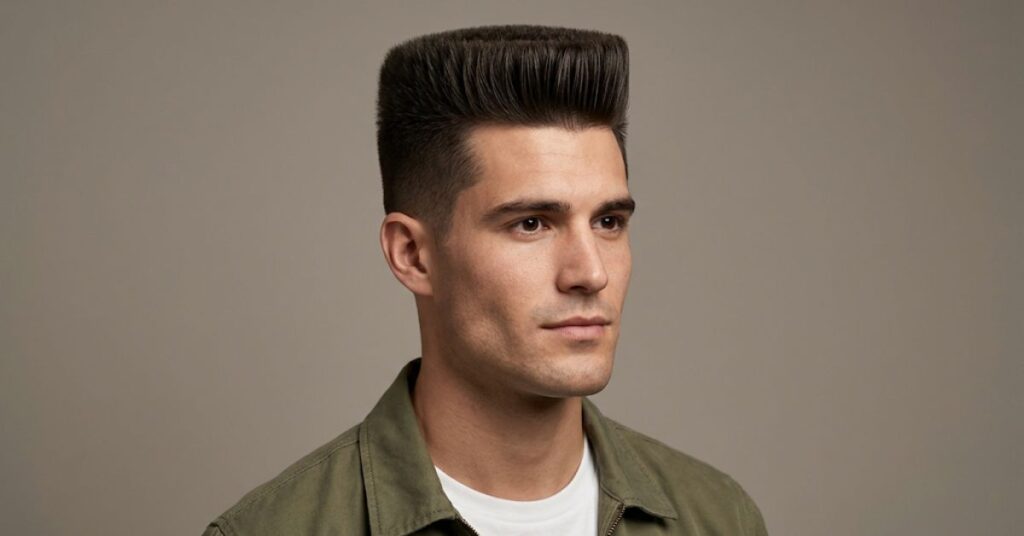
The flat top stands the hair straight up and cuts it level, so the top forms a flat deck. This medium version keeps more length and texture than the military original, which makes it easier to live with and less severe. The squared shape suits men with square or rectangular faces, because it echoes the jaw. For the stricter, shorter versions, best military haircuts shows how the same idea is cut at its shortest.
- Pick it if your hair is thick and grows straight up, because it will stand without much product.
- Skip it if your hair is soft or curly, since it will not hold the level top and will droop.
The level surface comes from clipper-over-comb cutting, so ask your barber to use that technique, and plan a trim every 2 to 3 weeks, because a flat top loses its edge quickly.
34. Greaser Slick Back

The greaser slick back combs the hair tight against the head with a high-shine product, so every strand lies in the same direction. The cut itself is simple, but the styling takes a few minutes each morning. It is the shiniest and most polished of the slicked looks in this list, which is what separates it from the minimalist version, where the hair is left natural.
To get the finish:
- Start with damp hair and comb it back with a wide-tooth comb to set the direction.
- Warm a small amount of high-shine pomade in your palms and work it from the roots to the ends.
- Go over the hair with a fine-tooth comb, so every strand is aligned.
- Wash it out at night with shampoo, since pomade left in dries out the scalp.
35. The Wavy Bro Flow

The wavy bro flow is the thick, wavy version of the flow, where the waves tuck behind the ears and run down toward the neck in a loose S shape. Compared with the natural wave flow above, it is longer and gets its shape from being swept back, not from an even cut. It suits thick hair, which has the weight to hold the sweep.
Ask your barber for:
- Thinning shears on the sides, so the waves do not puff out
- Length kept at the back and over the ears, so the hair can tuck behind them
- Scissor cutting on dry hair, so the barber sees where each wave sits
Dry it with a diffuser on low heat, or let it air dry, and finish with a little leave-in conditioner on the ends.
36. Curly Quiff

The curly quiff keeps the curls long on top and pushes them up and forward into a rounded peak, while the sides stay short so the shape is clear. That height helps on a round face, because it draws the eye upward. Curly hair springs up as it dries, so the top needs about 4 to 5 inches to land at quiff height. If your curls are tighter or shorter, short curly hairstyles for men show how the same idea works at a smaller scale.
To style it:
- Rake a curl-defining gel or cream through soaking-wet hair, then squeeze the hair upward in handfuls.
- Dry it with a diffuser on low heat, cupping the front from underneath to keep it lifted.
- Once it is dry, shake the curls out at the roots only, and keep a brush away from them.
Ask for short, even sides and book the next visit about two months out.
37. The Feathered Layer Cut

Feathered layers overlap like feathers, so the hair looks lighter and softer, with a flowing outline instead of a block. Thick, wavy hair benefits most, since the overlapping steps remove bulk and leave the length alone. The effect is longer-looking hair that does not feel bulky, which is the main reason to choose this over a plain scissor cut.
The cutting tool matters. A razor gives the wispiest ends, but it can fray coarse or frizzy hair, so ask for scissor layers with point cutting if your hair frizzes easily, and keep the razor for straighter, finer hair. Add a light leave-in conditioner on damp hair, and trim every 6 to 8 weeks, because feathered ends split if they are left.
38. Coiled Afro-Texture Mid-Fade

This cut keeps a medium-length top of tight coils over a mid fade, so the coils give height and the fade keeps the edges clean. Coiled hair shrinks as it dries, often to half its wet length, so the top needs more length than the finished look suggests. Dense hair suits this cut well, as the fade clears the sides and the top is free to keep its height.
Ask your barber for:
- A fade that begins at the temple and stays short through the back
- A crisp but natural line-up across the forehead and sideburns
- A quick tidy of the sides every two to three weeks, since a fade shows regrowth first
Coils dry out easily, so moisturise daily with a curl cream or leave-in conditioner, and detangle only when the hair is damp.
39. Long Wavy Fringe
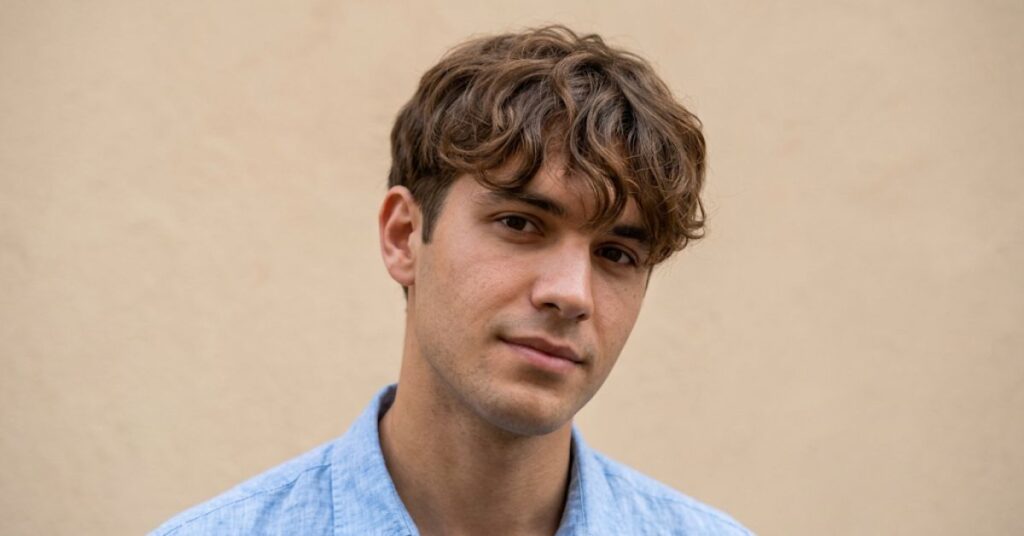
The long wavy fringe is a fringe that falls to eyebrow height or lower in loose waves, longer than the relaxed fringe above and softer than the messy fringe. It softens a strong jaw and gives a younger, less formal look. It only works if the hair has a natural bend, and dry, brittle ends will make the waves look frizzy instead of soft. Curtain hairstyles for men show how the same fringe looks when it parts in the middle.
Common mistake: keeping the back and sides too long. When everything is the same length, the fringe loses its shape and the whole cut looks unkempt. Have the sides and back cut a little shorter than the fringe, so the fringe stays the focus, and re-cut the front once it reaches your eyelashes.
40. The Bleached Textured Crop

Bleaching a medium-length textured top puts every layer on show, because light hair catches the light and the dark roots add depth. It is the highest-effort cut in this list, since the color needs as much upkeep as the cut. Lightening hair by more than about three shades needs stronger peroxide, which does more damage, according to the American Academy of Dermatology, so this cut suits healthy hair best.
Before you book:
- Book a licensed colorist instead of a box dye, and ask them to test a small strand first
- Ask for a deep point cut on top, so the bleached strands separate and move
- Expect a root touch-up every 4 to 6 weeks, plus a weekly conditioning mask
A weekly wash with purple shampoo cancels out the yellow that bleached hair picks up.
41. Asymmetrical Side Sweep

This cut leaves one side of the hair much longer than the other, so a diagonal line crosses the forehead. The longer side sweeps over and the shorter side is kept neat, which makes the face look angled. It suits high cheekbones and a confident personality, because the shape draws a lot of attention.
Most of the work is balance. The long side is heavy and can pull on the scalp or fall into the eye, so the barber should take a little weight out of it without shortening it. Part the hair on the side where it grows more easily, and check the shape in a mirror from the front, since a small error in the angle looks deliberate or sloppy depending on the day.
42. The Braided Mid Length

Braids add structure to medium hair, and a few thin ones in a loose cut look deliberate rather than neat. They also keep the hair away from the face during sport or work. The effect is rugged and slightly historical, and it works best on hair with some grip, such as wavy or slightly coarse strands, because very silky hair slides out of the braid.
Before you try it:
- Check the length: you need at least 5 to 6 inches on top for a braid to hold
- Start with one or two thin braids at the temples, then add more once you know how they sit
- Keep them loose at the root, since a tight braid pulls on the hairline and can cause breakage
Remove the braids and brush the hair out gently every few days, so the scalp can breathe.
43. The Hidden Undercut

The hidden undercut shaves the hair at the nape or just above the ears and covers it with the longer hair above. With the hair down it looks like an ordinary medium cut, and with the hair tied up, the shaved section shows. It is a good fit for an office that allows both looks. For bolder versions of the same idea, undercut hairstyles for men show the section left in full view.
- Pick it if your hair is thick enough to hide the shaved section and you like options in how you wear it.
- Skip it if your hair is thin, since the shaved section will show through even when the hair is down.
Ask for a #1 or #2 guard so the section stays tight under the top layers.
44. Emo Inspired Modern Shag

This cut has long, sweeping bangs and thinned sides, and it takes its look from emo styles of the 2000s. The hair is cut with a razor so the fringe falls in wispy pieces across the forehead. The modern version drops the flat-ironed finish and keeps the natural texture, which makes it softer and easier to wear. It also sits close to a standard shag, and shaggy haircuts for men show the same layers in a less dramatic form.
Common mistake: letting the bangs grow past the eyes and calling it the style. A fringe that blocks your vision is a problem for driving and reading, and it irritates the eyes. Ask for the fringe to be cut so it clears the eyes when you look straight ahead, and have the face-framing layers cut shorter than the rest.
45. The Viking Flow
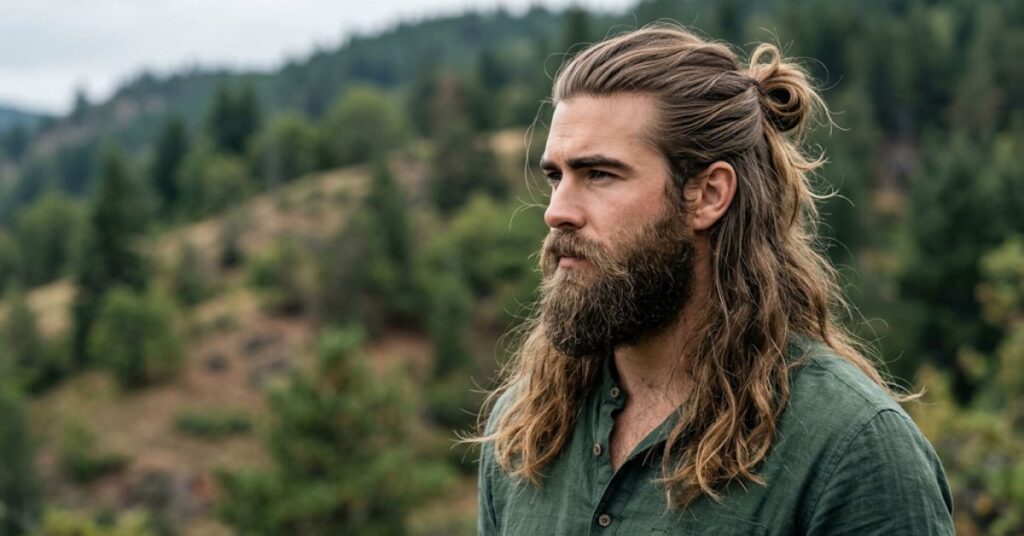
The Viking flow pulls the top half of the hair back into a small knot and leaves the rest hanging, so the shape is wide and heavy. It looks rugged and works best on thick hair with length, because there is enough hair to fill the knot and still look full below it. It suits a beard well, since both have a wild, full outline.
To get the shape:
- Take a section of hair from the crown and temples, and gather it loosely at the back of the head.
- Tie it with a hair elastic, and leave a few loose strands at the front.
- Pull the knot slightly looser than feels right, so the hair keeps its volume.
Trim the edges of the beard so the outline stays tidy, since the wild head hair needs a neat frame.
What to Ask Your Barber: The Exact Terminology
Knowing the right terminology ensures you and your barber are on the same page during the consultation. Using specific hair industry terms helps avoid a haircut disaster and guarantees the exact silhouette you envision. Clear communication is the foundation of a premium grooming experience that lasts for weeks.
Understanding Tapers vs. Fades for Medium Length
A taper gradually changes the hair length from the top down to the natural hairline without showing the skin. In contrast, a fade is much shorter and blends the hair down until it disappears into the scalp. For mid-length styles, a taper is often preferred to maintain a more balanced and classic look.
Point Cutting vs. Razoring: Which Texture is Right for You?
Point cutting involves using scissors at an angle to create soft, textured ends that add a lot of natural movement. Razoring, however, uses a straight edge to thin out the hair more aggressively for a wispy, “lived-in” feel. Choose point cutting for structure and volume, or razoring if you want to reduce bulk in very thick hair.
Mastering the “Awkward Stage”: From Short to Medium
Going from a buzz cut to medium length takes time. At about 1 cm (half an inch) of growth a month, reaching 3 inches usually takes five to six months. During that time the hair is too long to look short and too short to style, which is when most men give up and book a cut. A few simple cuts keep you neat while it grows.
3 “Transition” Cuts to Keep You Looking Sharp
Ask your barber for one of these while the hair grows:
- Hidden undercut (style 43): removes the messy hair around the ears, so the outline stays clean under the longer hair
- Low taper: cleans up the neck and sideburns while the top grows freely
- Textured crop: keeps the bulk on top in shape while the back reaches the length you want
Tell your barber you are growing it out, and ask for light trims on the sides and neckline only.
Step-by-Step Styling Masterclass (Prep, Blow-dry, Finish)
Styling takes about five to ten minutes once you know the order:
- Start with towel-dried hair that is damp, not dripping. Work a pre-styler such as sea salt spray or a light heat protectant through it.
- Blow-dry on medium heat, pointing the dryer at the roots and lifting the hair in the direction you want it to sit.
- When the hair is about 90% dry, switch to cool air to set the shape.
- Rub a pea-sized amount of clay (for textured looks) or pomade (for slicked looks) between your palms, then work it through the mid-lengths to the ends.
If the style collapses by midday, the usual cause is too much product at the roots or too little lift while drying.
Best Styling Products for Medium Length Hairstyles for Men
Building the right kit is essential because medium length hairstyles for men require more control and support than shorter cuts. Without the proper tools, your hair can quickly lose its shape or become flat throughout the work day. Investing in high-quality, salon-grade products ensures your hair stays healthy while maintaining the exact look you desire.
Sea Salt Spray: Secret to Natural Texture
Sea salt spray is a versatile pre-styler that adds “grit” and beachy volume to even the flattest hair types. It mimics the effect of ocean water, giving your strands a natural, matte texture that looks effortless and lived-in. Simply spray it on damp hair before blow-drying to create a strong foundation for any modern style.
Matte Clay vs. Pomade: When to Use Which?
Matte clay provides a strong hold with a dry finish, making it the best choice for messy, textured, or casual looks. Pomade, on the other hand, offers a higher shine and a slicker feel, which is ideal for professional side parts or vintage pompadours. Choose your product based on the occasion; use clay for daily wear and pomade for formal, high-impact events.
Final Tips for Maintaining Your Medium Length Haircut
Book a trim every 4 to 6 weeks to clean up the edges and remove split ends. Tapers and fades show growth sooner, so book earlier if you have one. Skipping trims is what makes medium hair look bulky or shapeless.
Between trims, wash two or three times a week, put conditioner on the ends, and keep dryer heat on medium or low. If you bleach or perm, space the treatments out and ask a licensed stylist how long to wait.
Conclusion
Medium length hairstyles for men work because they give you options. At 3 to 6 inches (7 to 15 cm), you can slick the hair back for work, leave it textured on the weekend, or let it grow toward a longer style. The best cut is the one that suits your face shape and hair texture, and that you can style in about ten minutes.
Before you book, pick one or two styles from the list, bring a photo, and say exactly what you want kept and what you want removed. After the cut, a trim every 4 to 6 weeks and a light routine are enough to keep the shape.
FAQs
Medium length means about 3 to 6 inches (7 to 15 cm) on top, which sits between a short fade and long hair. The hair is long enough to style in several ways, such as slicked back, swept to the side, or left textured, but short enough that it does not need a long-hair routine.
Every 4 to 6 weeks for most cuts. Tapered sides show growth sooner, so book a visit at 3 to 4 weeks, and a fade needs a touch-up every 2 to 3 weeks. Skipping trims is what makes medium hair look bulky or shapeless.
Hair grows about 1 cm (half an inch) a month, so reaching 3 inches usually takes five to six months. The awkward stage in the middle is the hardest part, and a low taper or a textured crop keeps you tidy while the top grows.
Ask your barber to remove weight from inside the hair with thinning shears and to keep the sides slightly shorter than the top. At home, use a leave-in conditioner on the ends and blow-dry in the direction you want the hair to sit. Thick or coarse hair puffs out fastest, so it needs this the most.
Cuts with height and movement, such as a textured quiff or short messy layers, make thin hair look fuller. Keep the sides short and tidy, and use a light mousse or sea salt spray instead of heavy gels. Very long layers can look wispy, so keep the length controlled.
Ryan Cole writes about men’s grooming, covering barbering techniques, current trends, and how styles adapt across different hair types and face shapes. He focuses on practical, wearable advice: how to describe a cut to your barber and how to maintain it day to day.