
A flow hairstyle for men is a medium-to-long cut where the hair sweeps back and to the sides in a loose, natural shape. People also call it the “bro flow.” It looks relaxed, but it still needs the right length and a little care.
This style works best on hair that is at least medium length. It needs only a light product and a few minutes of styling. It suits most face shapes and looks good in both casual and formal settings.
Most men like it because it takes less daily effort than a sharp cut. You grow your hair out, guide it back with your fingers, and let the shape form on its own.
This style stays popular in sports and fashion, so many men ask how to grow it and keep it neat. This guide covers face shapes, growing tips, styling steps, seven style options, and common mistakes.
Best Face Shapes for Medium Flow Haircuts
A flow cut works on most face shapes, but length and layers decide how well it fits you. The goal is to add width or height where your face needs it, and to soften the parts that look sharp.
Oval faces are the easiest to style because the proportions are already balanced. Almost any flow length works here, so you can choose based on your hair type and how much time you want to spend on it.
Square faces have a strong jaw and a wide forehead. Longer layers that fall around the jawline soften those angles. Keep the top loose instead of slicked flat, so the shape does not look harsh.
Round faces look best with height on top and slimmer sides. Brush the hair up and back, and keep the sides from getting too bulky. This makes the face look longer.
Heart-shaped faces have a wide forehead and a narrow chin. A side sweep or a few loose pieces over the forehead reduce its width. Length that reaches the chin adds balance to the lower half of the face.
How to Grow a Natural Flow Hairstyle
A flow hairstyle needs time more than anything else. Hair grows about 1 cm (roughly half an inch) per month, according to Cleveland Clinic. Because of that, most men need 6 to 12 months to go from a short cut to a full flow. Your starting length changes this number.
The awkward middle stage is the hardest part. Around months 3 to 5, the hair is too long to look short and too short to sweep back. During this stage, push it back with your fingers and use a little cream to stop the sides from sticking out.
If you start from a short cut of about 2 to 3 cm, this is roughly what to expect.
| Time | Approx. length | What to do |
| Months 0 to 2 | 2 to 5 cm | Stop cutting. Wash and condition as usual. |
| Months 3 to 5 | 5 to 8 cm | The awkward stage. Push hair back with your fingers and use a little cream. |
| Months 6 to 8 | 8 to 11 cm | The hair starts to sweep back. Get a light trim and tell your barber to keep the length. |
| Months 9 to 12 | 11 to 15 cm | Full flow length. Trim every 8 to 12 weeks. |
Trim your ends, but do not cut the length. Ask your barber for a light trim every 8 to 12 weeks. This removes split ends and keeps the shape even. Also tell your barber clearly that you are growing it out, so they do not take off too much.
Wash your hair two or three times a week with a mild shampoo. Then add conditioner to the lengths and ends, because softer hair falls back more easily. Limit heat as well. A blow dryer on low heat is fine, but hot tools dry the hair and cause breakage.
Food matters less than most people think. Enough protein, iron, and water support normal hair growth, but diet cannot push your hair past its natural speed. If you notice heavy shedding, see a doctor instead of buying supplements.
How to Style a Relaxed Flow Look
Styling a flow hairstyle takes about five minutes. Start with damp hair, not dripping wet and not fully dry. Pat it with a towel instead of rubbing it, because rubbing roughens the hair and causes frizz.
Take a small amount of light styling cream, about the size of a coin, and rub it between your palms. Work it through the hair from the roots to the ends. Start with less than you think you need. You can always add more, but you cannot take it out.
Push your hair back with your fingers instead of a comb. A comb makes the hair flat and neat, while fingers leave it loose and natural. If a section keeps falling forward, hold it back with your fingers for a few seconds while it dries.
A blow dryer helps set the direction. Use low heat and point the airflow backward while you push the hair back with your hand. Stop when the hair is dry. Extra heat after that only makes it frizzy.
Skip strong gels and hard waxes. They make the hair stiff and take away the movement that makes this cut work. If you want more texture, use a little sea salt spray on damp hair. Wavy hair will gain the most from it.
Best Flow Hairstyle Men Styles to Try
1. Classic Bro Flow Style

The classic bro flow is the standard version of this cut. The hair is long enough to cover the ears, and it sweeps back off the forehead in one smooth line. It works best on straight to slightly wavy hair, because that hair falls back on its own.
- Length: roughly 10 to 15 cm (4 to 6 inches) on top, with the sides covering the ears
- Best for: straight to slightly wavy hair of medium thickness
- Product: a light styling cream or a leave-in conditioner
- Where it fails: very curly hair springs up instead of lying back, and very fine hair can look flat
- Ask your barber for: “ear-length sides, long layers on top, no short fade
2. Layered Flow Hairstyle Men Look

The layered flow keeps the same swept-back shape, but the hair is cut in steps instead of one length. Shorter layers sit on top and longer ones fall below them. This removes weight, so thick hair stops puffing out at the sides and starts lying back with the rest.
Layers do not suit every head of hair. On fine hair, too many layers can leave the ends thin and see-through. If your hair is thick, ask for “long layers” and “point cutting at the ends” so the weight comes out without losing length. If your hair is fine, ask for only a few layers on top.
3. Wavy Flow Hairstyle

The wavy flow works with your natural texture instead of fighting it. Waves add width and movement, so the hair looks fuller even without much product. The main job here is controlling frizz and keeping the waves from turning into a puffy triangle.
- Let your hair air dry about 80% of the way, then finish with a blow dryer and diffuser on low heat.
- Apply sea salt spray or a light cream on damp hair and scrunch it upwards. Do not brush it once it dries.
- If the sides puff out, ask your barber to remove some weight from the sides while keeping the length.
4. Medium Length Flow Hairstyle Men

The medium length flow is the version most men can wear without much planning. The hair is long enough to push back and tuck behind the ears, but short enough that it does not need much product. It is also the stage you pass through while growing toward the longer styles above, so you can stop here and keep it.
- Pick this if you want a flow that looks neat at work and needs only a quick finger-style in the morning.
- Skip it if your hair is very curly or very thick and you want a lot of movement, because at this length it tends to stick out instead of falling back.
5. Hockey Flow Haircut Style

The hockey flow is the longest-at-the-back version of this cut. The top and sides are kept shorter and tidier, while the hair at the back and around the crown is left to grow and fall over the neck. From the front it looks like a normal flow, but from the side the length at the back is what gives it its shape.
This cut loses its shape faster than the others. Once the sides grow out, the line between the short sides and the long back blurs and the cut starts to look unplanned. Plan on a trim to the sides and neckline more often than you would for a classic flow, and keep the back as long as you want it. For a full breakdown of this cut, read our hockey haircut guide for men.
6. Textured Flow Hairstyle Men Style
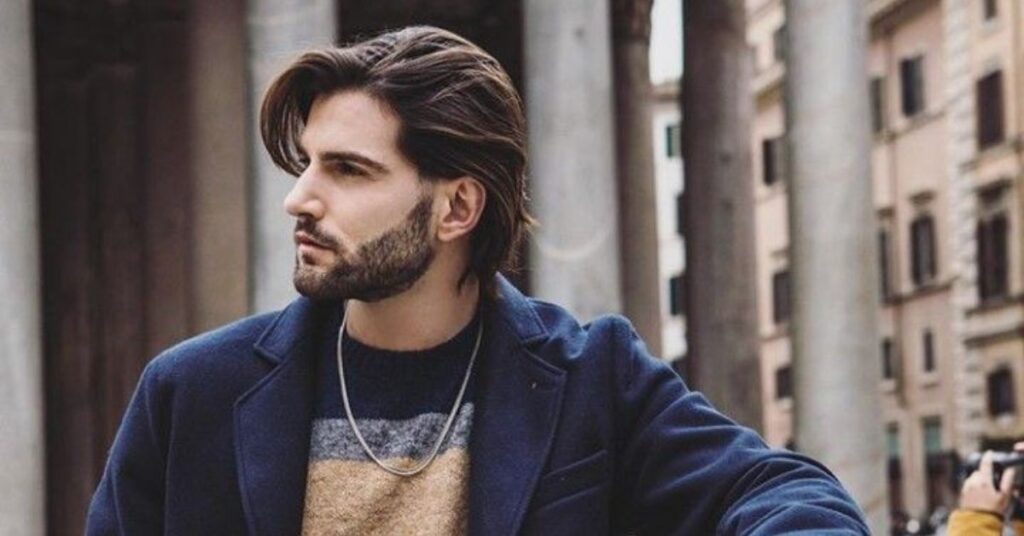
The textured flow is the same swept-back shape with a rougher, more broken-up finish. The difference from the layered flow is mostly in the styling, not the cut. Layers help, but the messy look comes from the product and how you apply it. It suits hair that is medium to thick, because thin hair does not hold texture well.
- Dry your hair fully first. Texture products work best on dry hair, unlike cream, which goes on damp hair.
- Rub a pea-sized amount of matte paste or clay between your palms, then run your fingers through the hair from the back to the front, and finally sweep it back.
- Stop when the hair has separation but still looks like one shape. If it looks stiff or shiny, you used too much. Wash it out and start again with half the amount.
7. Long Flow Hairstyle

The long flow is where the cut stops being a quick style and becomes a commitment. The hair reaches the collar or goes past it, and it moves as one piece when you turn your head. From a short cut this usually takes a year or more, so most men get here by growing through the medium stage first.
The trade-off is upkeep. Long hair tangles, and the ends get dry because the natural oils from the scalp take a long time to travel down. Conditioner on the lengths, a wide-tooth comb, and a trim every 8 to 12 weeks matter more here than at any other length.
Pick this if you like the look of longer hair and you are fine with tying it back on busy days. If you only want the relaxed shape without the maintenance, the medium length flow above gets you most of the way there.
How a Flow Hairstyle Works on Different Hair Types
The flow suits most hair types, but each one needs a slightly different approach.
Straight hair sweeps back easily but tends to lie flat. Add body with a little sea salt spray on damp hair, scrunch the roots upward, and dry it with a diffuser on low heat.
Wavy hair is the easiest to work with. The natural bend gives the flow its movement, so use light products and let it air dry most of the way.
Curly hair needs more control. Use a curl cream, and stretch the curls with a blow dryer and comb attachment before sweeping them back. Expect a fuller, puffier shape than on straight hair.
Fine hair looks sparse when it is long and heavy. Use light products, skip heavy oils, and keep the length around the medium range.
Thick hair needs weight taken out. Ask for long layers, and use a leave-in conditioner so the hair falls back instead of out.
Best Products for Soft and Natural Hair Flow
You do not need many products for this cut. Two or three are enough, and using too much is the most common reason a flow looks heavy or greasy. This table shows what each product does and how much to use.
| Product Type | What It Does | How to Use It |
|---|---|---|
| Light styling cream | Adds softness and light control without making hair stiff | A coin-sized amount on damp hair, daily |
| Sea salt spray | Adds grip and texture, mostly on wavy hair | 2 to 3 sprays on damp hair, not every day because it can dry hair out |
| Leave-in conditioner | Softens the lengths and reduces frizz | After washing, mostly on the mid-lengths and ends |
| Hair oil | Adds shine and smooths dry ends | 1 to 2 drops on the ends only, once or twice a week |
| Matte clay | Adds hold and a dry, matte finish. Good for textured or structured looks | A pea-sized amount on dry hair, worked through with your fingers |
| Water-based pomade | Adds medium hold and some shine. Works best on straight hair that needs shape | A small amount on the top layer only, on damp or dry hair |
Start with one product and add a second only if you need it. Fine hair does better with a spray and very little cream, while thick or wavy hair usually needs the leave-in conditioner more. Avoid anything labeled “strong hold” or “high shine,” since those work against the loose finish.
Maintenance Tips for Healthy Long Hair
Once the hair is long, the daily habits matter more than the products. Most damage to the flow hairstyle men grow out comes from small things done every day, like rough towel drying, brushing wet hair, or sleeping on a rough pillowcase.
Wet hair stretches and breaks more easily than dry hair. Detangle with a wide-tooth comb or your fingers, and start at the ends before moving up to the roots. If you hit a knot, work it out slowly instead of pulling through it.
- Sleep on a satin or silk pillowcase if you can, since it creates less friction than cotton and helps reduce frizz and breakage.
- Tie the hair back loosely when you exercise or swim, and rinse it with fresh water afterward because chlorine and salt water dry it out.
- Between trims, ask your barber to clean up just the neckline and around the ears, so the cut looks tidy while the length keeps growing.
Take care of your scalp too, because healthy hair starts there. If you get flakes or an itchy scalp, a gentle anti-dandruff shampoo once or twice a week usually helps. If it does not improve in a few weeks, check with a doctor.
Common Mistakes to Avoid in the Flow Hairstyle
Most problems with the flow hairstyle men try do not come from the cut itself. They come from a few habits that are easy to fix once you know them.
Giving up during the awkward stage is the biggest one. Around months 3 to 5, the hair looks messy and many men book a short cut just to feel tidy again. That resets the growth to zero. If the stage bothers you, ask for a trim that cleans up the shape and leaves the length alone.
Copying a style that does not match your hair type is another. A photo of thick, wavy hair will not look the same on fine, straight hair, however much product you use. Pick a reference photo from someone whose hair is close to yours, and show it to your barber.
Using product on the wrong hair state also causes problems. Cream on dry hair sits on top and looks greasy, while texture paste on wet hair does not grip. Cream and spray go on damp hair, and paste or clay goes on dry hair.
Telling your barber only “a trim” can cost you months. Say clearly that you are growing it out and how much length you want to keep. A short phrase like “take off half an inch, keep the length” removes the guesswork.
Conclusion
A flow hairstyle for men comes down to three things: enough length, a light touch with products, and the patience to get through the awkward growing stage. If you get those right, the rest of the routine takes only a few minutes a day.
Start by matching the style to your hair type and face shape, then pick one product and learn how much your hair needs. When you are ready for a trim, tell your barber exactly what to keep. If you are not sure how to explain the cut, our barber instruction generator can help you put it into words before your appointment.
FAQs
Hair grows about 1 cm (roughly half an inch) a month, so it depends on where you start. From a short cut, expect roughly 6 to 12 months. If your hair is already at medium length, it can take 3 to 6 months. The awkward stage around months 3 to 5 is the hardest part.
Not a full one. Hair needs around 10 cm (4 inches) on top before it can sweep back properly. With shorter hair you can push it back and style it, but it will stand up or fall forward. Use a light cream and keep growing.
Not once it has grown out. Daily styling takes about five minutes, and you need a light trim every 8 to 12 weeks. The harder part is the growing stage, and long hair needs conditioner and gentle detangling.
A light styling cream on damp hair works for most people. Wavy hair does well with sea salt spray as well. Avoid strong gels and hard waxes, because they make the hair stiff and take away the movement.
It suits most ages, but your hair density matters more than your age. Thin hair or a receding hairline can look sparse when it is grown long. If that is your case, ask your barber for a shorter, layered version.

Ryan Cole writes about men’s grooming, covering barbering techniques, current trends, and how styles adapt across different hair types and face shapes. He focuses on practical, wearable advice: how to describe a cut to your barber and how to maintain it day to day.